
Canine Rehabilitation. Not just Canine Hydrotherapy
There’s such a misconception by both vets and pet owners that Canine Rehabilitation means Canine Hydrotherapy.
And that’s so not the case.
Although beneficial in specific cases the reality is that rehabilitation involves much more than just one modality and the underwater treadmill is just one part of an overall treatment program.
In the human world this would translate into all Physical Therapists recommending water therapy for all their patients irrespective of their condition which of course they don’t.
In our 10+ years experience 4 out of 5 canine patients referred to our former rehab practice for hydrotherapy were not suitable candidates, at least NOT as initial therapy. We even had cases of paralysed dogs being referred for hydro in the hope that it would help them walk again.
This showed that people just didn’t have a full understanding of what this modality can and can’t do.
Hydrotherapy for Arthritis and Post Op Recovery
A common use of the underwater treadmill is in managing dogs with arthritis and those recovering from orthopaedic surgery. This is based on the premise that the buoyancy of the water reduces the stress on the various joints allowing them to move these joints in a supported environment therefore avoiding further injury and developing strength along the way.
The truth is while it is possible to add some strength in patients who have lost condition it is not a long term strength building strategy. Also hydrotherapy is designed for overall conditioning and can’t be used to target specific problem areas.
In order to build strength and generate muscle growth muscles and tendons need to be gradually loaded with progressive resistance which can only be achieved through strength training exercises which unlike hydrotherapy, can be tailored to target specific areas of concern.
Continuously only using the treadmill will build stamina as they walk longer and longer distances but the downside of this “one size fits all” approach is that it can lead to overuse injuries due to the repetitive nature of the exercise.
For these conditions a combination of water AND manual therapies (using body weight as resistance) is required for long term injury prevention and overall well being.
Why You Need a Professional Assessment before starting a Canine Hydrotherapy Program
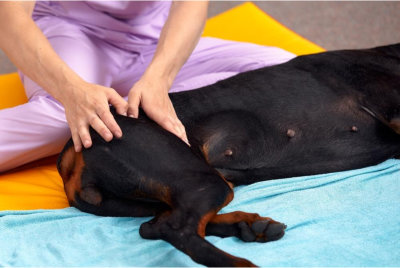 A good example here would be a dog with an abnormal gait.
Putting this dog in an underwater treadmill would just promote the progression of that abnormal gait.
A rehab therapist needs to first diagnose the reason for that abnormal gait and address that first before looking at building endurance in the underwater treadmill.
In these cases you’d be starting the treatment program with manual therapies, such as therapeutic exercises, massage, Laser Therapy or other suitable modalities and then consider providing Hydrotherapy with support in correcting the gait in the water. (Support in the water means the therapist is in the water with the dog to guide the positioning and movement)
Without a professional assessment – you could be doing more harm than good.
Who is Qualified to give a Professional Assessment?
In the Canine rehab world this is called a Rehabilitation Assessment.
This should only be performed by Qualified Canine Rehabilitation Professionals who have undergone the necessary further training and Certification in this field.
These are:
Vets who have become certified in Canine Rehabilitation through recognised institutions
Human Physical Therapists (Physiotherapists / Chiropractors) who have undergone the same further training and Certification in Canine Rehabilitation / Physiotherapy
Qualifications are also required for Hydrotherapists
These are people who have completed specific training to be able to operate the Underwater Treadmill safely and provide treatment programs as prescribed by a Qualified Rehabilitation Professional.
Be aware that anybody can purchase an Underwater Treadmill and open a Canine Hydrotherapy Facility. This is why we always recommend checking out the credentials of the therapists before referring and entrusting the care of your dog to them.
Having an underwater treadmill acts as a great marketing asset as it is perceived as the be all and end all of rehab.
But it isn’t a magical tool that all patients can benefit from.
And if you’re a qualified professional just starting out in Canine Rehabilitation, there are many other modalities and treatments you can provide for your patients that don’t need you to immediately invest in a Hydrotherapy Unit and the extra space you need to accommodate it.
That can always come later.
Again in our experience most of our canine patients were treated through manual hands on therapies and therapeutic exercises with hydrotherapy being used only around 20% of the time.
You can start with for example – Laser Therapy and therapeutic exercises or massage or Acupuncture and still achieve wonderful outcomes for your patients
You may also be interested in …
 https://www.drmalcolmware.com.au/wp-content/uploads/2024/03/Canine-Hydrotherapy-2.jpg
401
602
Ivana Katz
https://drmalcolmware.com.au/wp-content/uploads/2024/03/Dr-Malcolm-Ware-Logo.png
Ivana Katz2024-03-27 01:36:582024-03-28 01:25:15Canine Rehabilitation. Not just Hydrotherapy
https://www.drmalcolmware.com.au/wp-content/uploads/2024/03/Canine-Hydrotherapy-2.jpg
401
602
Ivana Katz
https://drmalcolmware.com.au/wp-content/uploads/2024/03/Dr-Malcolm-Ware-Logo.png
Ivana Katz2024-03-27 01:36:582024-03-28 01:25:15Canine Rehabilitation. Not just Hydrotherapy

