

There’s no doubt Veterinary care has come a long way over the last few decades. With so many advances in diagnostics – medicine and surgery, our clients and their pets now have access to some amazing technology and treatment options that completely rivals human health care.
In short, there appears to be no limit to what we can do to help our beloved pets.
We have specialists in every field we can refer to and state of the art hospitals that offer everything from emergency services to high end medical and surgical care.
But there’s still something missing.
Picture this: a three-pronged approach encompassing medicine, surgery, and preventive care forms the backbone of most veterinary practices. Together, they tackle a multitude of conditions, achieving positive outcomes for countless patients.
But here’s the catch—not all cases fit neatly into this framework. Some require an additional dimension of care, and that’s where rehabilitation steps in to complete the picture.
Rehab Completes the Vet Care Picture
Rehab isn’t a standalone area of Vet med – it plays a role in all three areas. Especially when it relates to chronic disease management such as Arthritis, and other musculoskeletal conditions.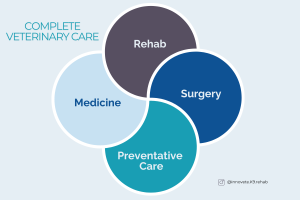
It addresses the functional aspect of disease.
As veterinarians we’re focused mainly on the pathological aspect of disease and its treatment and cure.
Rehabilitation is focused on optimising the patient’s response in relation to function and not just on a specific medical diagnosis
Therapists think in functional diagnosis as distinct from the medical diagnosis
It’s based on a different model and looking at different aspects of the condition.
- Pathology = medical diagnosis – back pain – knee pain – hip dysplasia etc
- Impairment = What abnormality that pathology causes – physical – emotional – anatomical
- Functional limitations = How it limits their daily performance
- Disability = how this functional disability affects them and their owners
Does this mean all Vet practices should offer Rehab?
No. Not at all. However it is your responsibility as a veterinarian to know how rehab fits into a treatment plan and refer the appropriate cases to someone who can provide that care.
Just because you don’t know how something works is not an excuse to reject it and not offer the service to the client. After all, it’s their choice whether to proceed or not.
Thinking back to the times we had new clients come to us for rehab, one of the most common first questions they’d ask is “Why didn’t my vet refer me for this treatment?”
My answer was simply “I don’t know. Maybe they didn’t know enough about it to confidently recommend it. Maybe there were other reasons. I have no idea.
There’s no excuse not to promote rehab to your clients
Today there is no excuse to be ignorant about Rehab and the role it plays in complete care of our patients.. There is plenty of information available to include case applications, case studies, published papers and client testimonials.
In city areas there is now an abundance of highly skilled and qualified therapists that you can reach out to and work together with.
They’re not your competitors. Instead view them as partners in your patient’s care.
After all, it’s no different to how the Human Medical model works. Surgeons and GP’s refer to Physical Therapists all the time because they know they provide the therapy the patient needs as part of a comprehensive treatment plan.
Rehab professionals offer a variety of therapies that help manage chronic and painful conditions.
Some of these include:
- Hydrotherapy
- Laser Therapy
- Therapeutic Exercises
- Acupuncture
- Shockwave Therapy
- Massage & Myotherapy and more
How do You build a working relationship with Rehab Professionals?
Search for rehab therapists in your local area and areas where you draw your clients from. Check them out online then contact them personally to find out more about them and what they can do to complement your services.
You’ll find some are mobile and others operate from a facility. Both options can be useful for your clients.
Once you’ve settled on a few providers you feel comfortable referring to – ask for their brochures or make up a handout of your own listing your preferred providers.
Or you could go a step further and invite them for a “Lunch and Learn” or other meeting where they can help educate your team on what they do. This is a great relationship builder.
Remember – you share the same goals which are restoring and maintaining pet health and wellbeing.
Referral won’t lose you clients
Finally I’d just like to add that you don’t need to fear losing your client when referring them for rehab therapies.
On the contrary, it demonstrates your commitment to comprehensive care, strengthening the bond between you and your clients. Most pet owners continue to entrust their furry friends’ routine needs to their regular veterinarian, recognizing that referral for specialised therapies is simply part of the holistic approach to their pet’s health.
So, let’s embrace rehabilitation as the missing piece in our quest for complete veterinary care.
Together, we can elevate the standard of treatment, ensuring that every pet receives the comprehensive care they deserve.
You may also be interested in ….
 https://www.drmalcolmware.com.au/wp-content/uploads/2024/11/Blog-Featured-image.png
628
1200
Gaby Ware
https://drmalcolmware.com.au/wp-content/uploads/2024/03/Dr-Malcolm-Ware-Logo.png
Gaby Ware2024-11-04 07:49:532025-12-28 07:10:17Is your Pet’s Rehab Therapist Qualified?
https://www.drmalcolmware.com.au/wp-content/uploads/2024/11/Blog-Featured-image.png
628
1200
Gaby Ware
https://drmalcolmware.com.au/wp-content/uploads/2024/03/Dr-Malcolm-Ware-Logo.png
Gaby Ware2024-11-04 07:49:532025-12-28 07:10:17Is your Pet’s Rehab Therapist Qualified? https://www.drmalcolmware.com.au/wp-content/uploads/2024/09/Blog-Featured-Image-Graphic-1.png
628
1200
Gaby Ware
https://drmalcolmware.com.au/wp-content/uploads/2024/03/Dr-Malcolm-Ware-Logo.png
Gaby Ware2024-08-22 11:09:432024-11-04 07:53:59Why Laser Therapy is Perfect for Mobile Vets and Therapists
https://www.drmalcolmware.com.au/wp-content/uploads/2024/09/Blog-Featured-Image-Graphic-1.png
628
1200
Gaby Ware
https://drmalcolmware.com.au/wp-content/uploads/2024/03/Dr-Malcolm-Ware-Logo.png
Gaby Ware2024-08-22 11:09:432024-11-04 07:53:59Why Laser Therapy is Perfect for Mobile Vets and Therapists https://www.drmalcolmware.com.au/wp-content/uploads/2024/07/shutterstock_2201274909-1.jpg
666
1000
Gaby Ware
https://drmalcolmware.com.au/wp-content/uploads/2024/03/Dr-Malcolm-Ware-Logo.png
Gaby Ware2024-06-17 00:09:382024-07-17 00:41:55VETS: 5 Reasons that may be stopping you from referring patients for Physical Therapy and Rehabilitation
https://www.drmalcolmware.com.au/wp-content/uploads/2024/07/shutterstock_2201274909-1.jpg
666
1000
Gaby Ware
https://drmalcolmware.com.au/wp-content/uploads/2024/03/Dr-Malcolm-Ware-Logo.png
Gaby Ware2024-06-17 00:09:382024-07-17 00:41:55VETS: 5 Reasons that may be stopping you from referring patients for Physical Therapy and Rehabilitation


